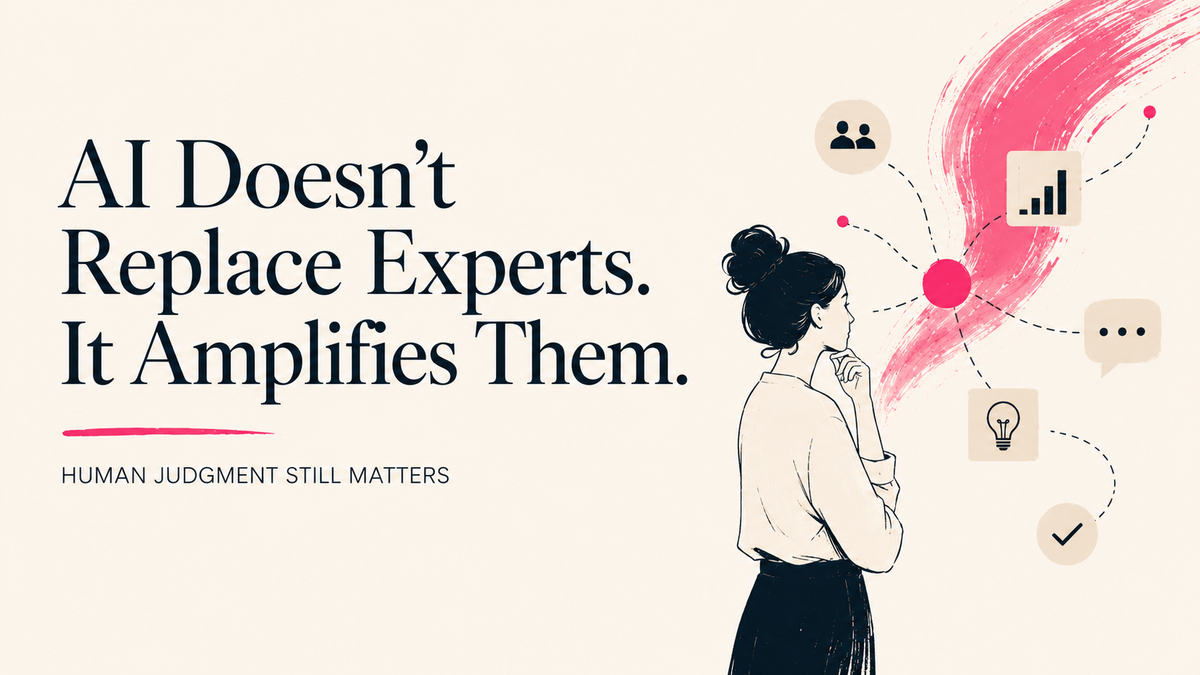
AI Doesn't Replace Experts. It Amplifies Them.
AI doesn't replace experts. It amplifies them. Learn why curiosity, judgment and human-in-the-loop collaboration matter more than ever, and how leaders can help teams experiment, learn and turn AI into a force multiplier.
For the last several years, we've been asking the wrong question.
Will AI replace knowledge workers?
It's an understandable question, but I don't think it's the most interesting one. A better question might be: How can AI help talented people become even more effective at what they do?
Because AI is a tool. And like every tool that has come before it, its value depends largely on the person using it.
A calculator doesn't replace an accountant. Photoshop doesn't replace a designer. Spreadsheets didn't replace analysts. They changed how work was performed and gave experts new ways to create value. I believe AI will do the same.
AI Is a Force Multiplier
AI excels at many things. It can summarize information, organize ideas, generate first drafts, synthesize research and accelerate repetitive tasks. It can help us move faster and make knowledge more accessible.
Those capabilities are remarkable, but they don't eliminate the need for expertise. They increase the impact of expertise.
In my own work, AI has become an invaluable thought partner. It helps me brainstorm, challenge assumptions, organize ideas and accelerate writing. But it doesn't decide which ideas matter. It doesn't understand organizational dynamics. It doesn't know my audience. It doesn't replace judgment.
That's still my job.
Technology creates leverage. People create value.
Human Judgment Matters More Than Ever
As AI becomes more capable, I don't believe human expertise becomes less important. I suspect the opposite is true.
Why? Context matters. Taste matters. Ethics matter. Relationships matter. Prioritization matters. Judgment matters.
AI can generate ten ideas in seconds. Knowing which one to pursue still requires experience. AI can summarize a meeting. Understanding the political and emotional dynamics behind that conversation requires human insight. AI can create options. People decide which tradeoffs are worth making.
Human-in-the-loop isn't a limitation of AI. It's one of its greatest strengths.
The best outcomes often come from collaboration between machine intelligence and human expertise.
Curiosity Is the Competitive Advantage
The skill I believe matters most in the AI era isn't prompt engineering.
It's curiosity.
The people who will benefit most from AI are not necessarily the most technical. They are the people who remain open-minded, continue learning and stay curious about what is possible.
They experiment. They ask questions. They challenge assumptions. They adapt.
In a world where technology changes rapidly, curiosity may be more valuable than certainty.
Five Ways Leaders Can Amplify Expertise
Leaders play an important role in helping teams adopt AI successfully. The goal isn't simply to deploy new tools. The goal is to create an environment where people can learn, experiment and share what they discover.
1. Give Teams Time to Learn
Learning requires space. If everyone is operating at full capacity, experimentation becomes impossible. Curiosity cannot thrive when every minute is already spoken for.
2. Create Space for Mistakes
New tools always come with wrong turns and failed experiments. That's part of the process. Teams need permission to try, learn and adjust without fearing that every mistake will be held against them.
3. Trust the People Closest to the Work
The people doing the work often have the clearest view into where AI can help and where it might introduce risks. Leaders don't need all the answers. They need to listen to the people discovering them.
4. Share What Works
Individual breakthroughs become organizational capabilities when people document what they learn and teach others. Communities of practice, playbooks and open conversations help expertise scale.
5. Invest in People, Not Just Tools
AI platforms will continue to evolve. Expertise, judgment and relationships remain enduring advantages. Organizations that invest only in technology will struggle to realize its potential. Organizations that invest in people will find ways to continuously create value with whatever tools emerge next.
The Real Opportunity
I don't think AI replaces experts. I think it amplifies them.
Talented people know how to ask better questions, recognize better answers and apply technology in thoughtful ways. They understand context. They exercise judgment. They know when to trust the machine and when to challenge it.
AI may change how work gets done, but it doesn't diminish the importance of expertise. In many ways, it elevates it.
Tools don't replace craftspeople. They help craftspeople do extraordinary things.