If You Have Teenagers, You Already Know Something About Managing AI
Managing AI is surprisingly similar to parenting teenagers: clear instructions only go so far. Context, autonomy, feedback and shared expectations are what turn direction into good judgment.
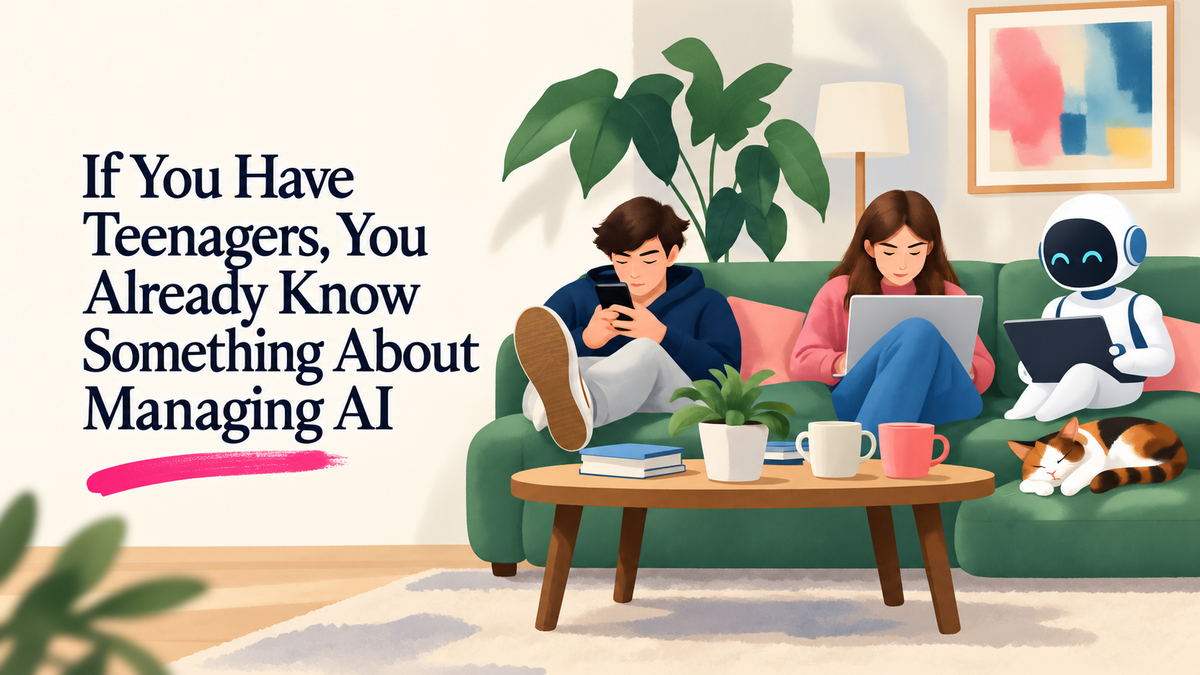
My kids are teens, so this involves the usual daily negotiations around food, rides, school, laundry, bedrooms, feeding cats and the seemingly limitless number of household tasks that can be interpreted differently from how I intended them.
At the same time, I've been spending a lot of my workday thinking about AI teammates: What they should do, what they need to know, how much autonomy they should have and how we teach them to work within the systems and standards of an organization.
Somewhere between reminding a teen for the hundredth time that putting something away includes closing the cabinet door and reminding ChatGPT for the hundredth time that my blog support images should be separate files with no text, I had a realization:
Managing AI is surprisingly similar to parenting teenagers.
Not because teens are robots. And certainly not because AI is capable of replacing teenagers, although I remain open to proposals involving laundry and meal plans.
It's because both reveal an uncomfortable truth about communication:
We vastly overestimate how much of what's in our heads has successfully made it into someone else's.
"But I told you"
This may be one of the most frequently uttered sentences in our house. I told you to clean your room. I told you to feed both cats. I told you where that goes. I told you what time we were leaving.
And increasingly, I find myself having the same reaction to AI. I told you not to put text on the image. I told you what size the file should be. I told you the tone to use for ops comms, I even made you an .md file. Do you need me to point out our last conversation on this matter?
There is a particular kind of frustration that comes from believing you have communicated something clearly and discovering that the recipient has somehow developed an entirely different interpretation.
But "I told you" isn't actually a very useful management strategy.
The more interesting question is: Why wasn't what I told you enough?
Sometimes the instruction wasn't as clear as I thought. Sometimes the person — or AI — didn't have the context required to make the judgment I expected. Sometimes I gave a task without explaining the outcome. Sometimes there are too many rules to remember. And sometimes, yes, the instruction was perfectly clear and my teenager (or GPT) simply chose not to do it.
We communicate outcomes. They hear tasks.
"Feed the cats" sounds like a complete instruction.
What I mean is: Feed both cats. Dump out the old dry food and replace it. Put dirty bowls in the sink. Clean out and refill the water. Give them wet food, but check the fridge for a can first. Sweep up their crumbs on the floor. If you spill water or food, clean it up. Rinse the dirty bowls and put them in the dishwasher. I shouldn't need to become involved in the cat-feeding operation. We do this twice a day, every day.
That's a lot of implied context packed into three words.
The same thing happens at work. We tell someone to "create the presentation," "update the campaign" or "review the brief." Experienced employees learn that those requests carry dozens of unwritten expectations. They know the audience. They know the brand. They know what the executive hates. They know which template to use, which stakeholder needs to see it and what "done" actually looks like.
Then we give the same task to AI and are surprised when it produces something technically correct and completely wrong. The AI didn't necessarily fail the task. It may have completed the task we gave it rather than the one we meant. That's an important distinction.
Context is what turns instructions into judgment
I've been thinking about this a lot as we experiment with AI teammates. The interesting question isn't simply, "Can AI do this?" Increasingly, I'm more interested in asking:
What would have to be true for AI to do this to our standard?
That's a very different design problem. What would the AI need to know about our organization? What does it need to understand about the work? What examples should it see? Which rules matter? What should it do when information is missing? When should it make a judgment, and when should it ask for help?
It's remarkably similar to what happens as kids get older. When they're little, instructions can be fairly procedural. Put this here. Do this next. Don't touch that.
As teens become more independent, the goal changes. I don't actually want to create increasingly elaborate instructions for every situation they will encounter. I want them to develop enough context and judgment to figure out what to do when I'm not there.
That's also where AI becomes much more interesting. The goal can't be writing a 47-step prompt for every task forever. The goal is building enough shared context that the AI can make more of the right decisions without being explicitly told each time.
Autonomy isn't binary
Teens also provide a useful lesson in autonomy. There are things my kids can handle completely on their own. There are things I want to know they're doing but don't need to supervise. There are things where I want to check the result. And there are things where they absolutely need an adult in the room.
We don't give teens either zero autonomy or complete autonomy. We calibrate it based on the task, their experience, the consequences of getting it wrong and the judgment they've demonstrated. AI needs the same kind of thinking.
A low-risk, highly repeatable task might need very little human oversight. Something involving brand judgment, sensitive information, significant financial impact or an external customer may require much more. The question shouldn't be: Do we trust AI? That's far too broad.
A better question is: What level of autonomy is appropriate for this particular job? And then we adjust as capability improves.

Don't give one teen every chore
This is where the analogy becomes especially useful for AI agents. I'm increasingly skeptical of the idea that we should build one giant AI assistant that knows everything and does everything.
We don't design human organizations that way. We create roles. Someone owns this. Someone else owns that. People develop expertise. Responsibilities are clear. Work moves between people when different skills are needed.
AI teammates can work similarly. A small agent with a clearly defined job is easier to train, easier to evaluate and easier to improve. It needs the context relevant to its work rather than everything the organization has ever known.
Then multiple specialized agents — and humans — can work together as part of a larger system. This is less like installing software. It's more like designing a team.
"I shouldn't have to tell you this every time"
This is another sentence familiar to anyone who has lived with teenagers. And, lately, anyone who works regularly with AI. There's an organizational lesson hiding inside the frustration.
If something needs to happen consistently, it probably shouldn't depend entirely on someone remembering that I said it once.
Families create routines (and laminated checklists if you are crazy like me). Teams create processes. Organizations create standards, documentation and systems.
If I constantly have to tell an AI teammate which brand rules matter, how requests should be prioritized, what good looks like or when it should escalate something, those aren't really AI problems. They're signals that important operating knowledge hasn't been encoded into the system yet.
This is one of the things I find most interesting about working with AI: It exposes how much of an organization's operating model lives in people's heads. AI makes the weakness of undocumented knowledge especially visible.
Training AI forces us to make that invisible context visible. And once we've done that, the documentation isn't only useful to the AI. It's useful to everyone.
Don't confuse a bad result with a bad human
This may be the hardest management lesson, whether you're dealing with humans or machines. Something goes wrong and our instinct is to judge the result. Why did you do that? Why didn't you know? Why can't you follow the instructions? What's wrong with you???
Sometimes that's warranted. But before concluding that the person — or the technology — isn't capable, it's worth examining the system around the failure.
Did they have the information they needed? Were the expectations actually clear? Did two instructions conflict? Did we explain what success looked like? Did we give them authority to make the decision? Did they know when they were supposed to ask for help?
Managers (and parents) should already be asking those questions about people (and teens). AI simply makes the consequences of not asking them much more obvious.
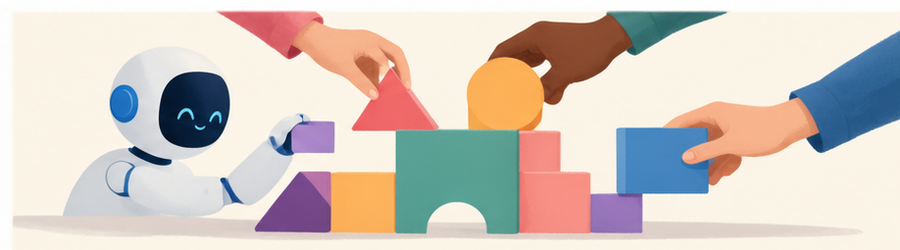
The goal is not perfect compliance
There is, of course, one enormous difference between managing teenagers and managing AI. My kids are supposed to grow into independent adults with their own opinions, priorities and lives. My AI teammates are not. Thank God.
But there's something similar about the direction of travel. I don't want to spend my life standing behind my teenagers giving them increasingly detailed instructions about how to complete every task. And I don't think the future of working with AI is humans writing increasingly elaborate prompts telling machines exactly what to do.
In both cases, the goal is to build enough context, clarity and judgment that I can increasingly say: You know what we're trying to accomplish. Go handle it.
Then I stay close enough to help when the situation requires me. Maybe that's why the idea of an "AI teammate" resonates with me more than an "AI tool."
Tools don't need onboarding. They don't need context. They don't need clearly defined roles or decision rights. They don't need feedback loops.
Teammates do. And apparently, so do teenagers.
Now, if someone can build me an agent that closes cabinet doors, we'll really be getting somewhere.
Categories: AI & Tools, Leadership, Creative Ops