The Workaround Is Trying to Tell You Something
Workarounds aren't always resistance to change. Learn how unofficial workflows can reveal opportunities to improve processes, collaboration and organizational design.
What the unofficial ways people get work done can teach us about designing better systems.
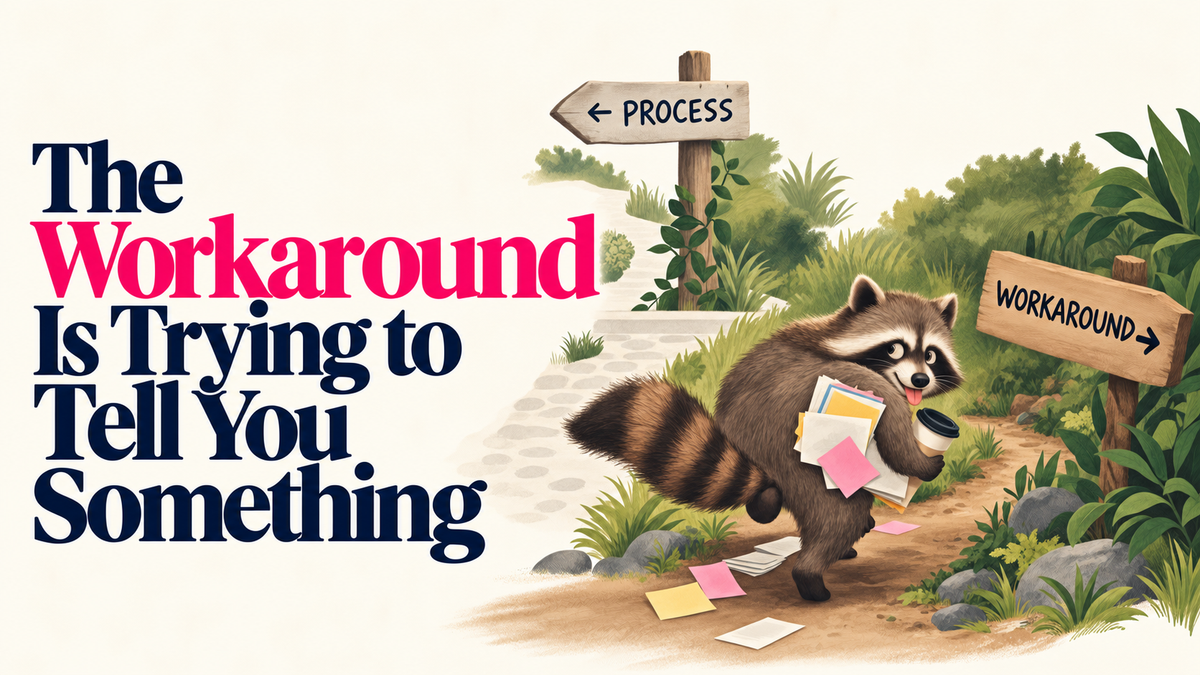
Every organization has two ways of getting work done.
There's the official way. The documented process, the approved tools, the intake forms, the workflows and the carefully designed steps that explain how work is supposed to move through the organization.
And then there's the way people actually get things done.
Someone sends a Slack message instead of submitting a request. A project manager maintains a spreadsheet because the official system doesn't give them the view they need. A creative director keeps a personal list of priorities because the team hasn't agreed on which work matters most. Someone creates a template that quietly becomes more useful than the official documentation.
We tend to call these workarounds.
And when we're trying to build consistent, scalable ways of working, our first instinct is often to eliminate them.
But I've started thinking that workarounds deserve a little more curiosity.
Because sometimes the workaround is telling us something the process isn't.
People rarely create extra work for fun
Most people aren't looking for opportunities to maintain another spreadsheet, update another document or manage another communication channel.
They create workarounds because something about the existing system isn't meeting their needs.
Maybe the process takes too long. Maybe it requires information they don't have yet. Maybe it works beautifully for one team but creates friction for another. Maybe the official tool technically supports what they need to do, but nobody has figured out how to make it practical.
Sometimes the workaround exists because the process was designed around an ideal scenario rather than the messy reality of getting work done.
And sometimes people simply don't understand why the official process matters.
That last one is particularly interesting to me. If someone sees an intake form as administrative overhead rather than the mechanism that helps the organization understand demand, plan capacity and make informed trade-offs, of course they're going to look for a shortcut.
From their perspective, they're being efficient.
From the team's perspective, they're creating invisible work.
Both things can be true.

The workaround is a clue, not a verdict
I'm not suggesting that every workaround is brilliant or that we should abandon governance whenever someone finds a faster route.
Some workarounds create genuine risk. They hide information, bypass important approvals, fragment decisions or shift work onto people who don't have the capacity to absorb it.
But before deciding how to respond, I think it's worth understanding what the workaround is accomplishing.
Consider a stakeholder who regularly bypasses the creative intake process and messages a designer directly.
It's tempting to see this as someone refusing to follow the rules.
And perhaps that's exactly what's happening.
But there are other possibilities worth exploring.
Does the stakeholder know where to submit a request? Do they understand what happens after submission? Are they confident someone will respond? Does the process accommodate early conversations when the request isn't fully formed?
Or has their experience taught them that messaging a designer is the only reliable way to get an answer?
Those questions don't excuse bypassing the process. They help us understand why the behavior persists.
And understanding that gives us more useful options than sending another reminder about following the rules.

Sometimes the workaround is the innovation
One of the interesting things about operational transformation is that the people closest to the work often discover useful solutions long before those solutions become official.
A team creates a simple checklist that eliminates a recurring source of confusion. Someone builds a view that makes priorities easier to understand. A producer develops a better way to prepare stakeholders for creative reviews.
None of these necessarily began as formal initiatives.
They began because someone noticed friction and found a practical way around it.
If we're too focused on enforcing the existing process, we risk overlooking improvements that are already happening.
That's why I think Creative Operations needs to do more than document how work should happen.
We need to pay attention to how work actually happens.
The gap between those two things is often where the most interesting opportunities live.

Standardization shouldn't mean ignoring reality
There are good reasons to standardize work. Shared processes create visibility, consistency and accountability. They help teams coordinate across functions and make it possible to understand demand, capacity and performance.
Without some common structure, every project becomes a custom negotiation about how to get something done.
But standardization works best when it's built around genuine needs, not simply the desire to make everyone behave the same way.
A useful process should make the right behavior easier. If the official way of working is consistently harder than the unofficial way, we have a design challenge.
That doesn't necessarily mean removing steps. Sometimes an approval exists for an important reason. Sometimes a required field protects the team from starting work without enough information.
The opportunity is to make the purpose clear, remove unnecessary friction and help people understand how their individual actions affect the larger system.
A good operating model balances flexibility with the consistency required to work together.
Five questions worth asking about workarounds
The next time you discover an unofficial spreadsheet, a side-channel approval process or a creative team maintaining its own tracking system, resist the urge to immediately shut it down.
Start with a few questions.
1. What need is this workaround meeting?
Understand what the person is trying to accomplish and why the official process isn't getting them there.
2. What does the workaround make easier?
Look for speed, clarity, accessibility or flexibility that the current system might be missing.
3. What does it make harder for everyone else?
A shortcut for one person can create additional work, missing information or risk for another team.
4. Is there something worth adopting?
Sometimes the best improvement has already been invented by someone doing the work.
5. What would make the official process the easier choice?
This is the question that moves us from enforcement to design.
Not every workaround should become standard practice. But every recurring workaround deserves to be understood.
Design for the work you actually have
I think one of the biggest mistakes we can make during transformation is assuming that implementing a process means we've solved the underlying challenge.
We launch the tool. We publish the documentation. We train the team. We communicate the expectations. And then we're surprised when people continue doing things differently. But adoption isn't just about whether people know the process exists.
It's about whether the process works well enough in the reality of their day-to-day jobs that they choose to use it. That requires ongoing observation, feedback and a willingness to improve what we've built.
It also requires some humility. The system we designed with the best intentions may not be the system people actually need.
Creative Operations is ultimately about creating an environment where good creative work can happen consistently. That means paying attention not only to the official workflows, but also to the informal behaviors that emerge around them.
Because those behaviors are telling us something.
The goal isn't to eliminate every workaround. It's to build a system that makes fewer workarounds necessary.
And sometimes the most useful improvement begins with asking someone why they're doing things differently.
What's a workaround you've seen that revealed an opportunity to improve how work gets done?
Categories: Creative Ops, Transformation, Leadership
If you’d rather get Make Creative Work in your inbox, you can subscribe here: https://www.makecreativework.com/#/portal/signup