Creative Quality Is a System
Creative quality isn’t just about talent. How feedback, expertise and decision rights are structured can strengthen great creative work — or slowly dismantle it.
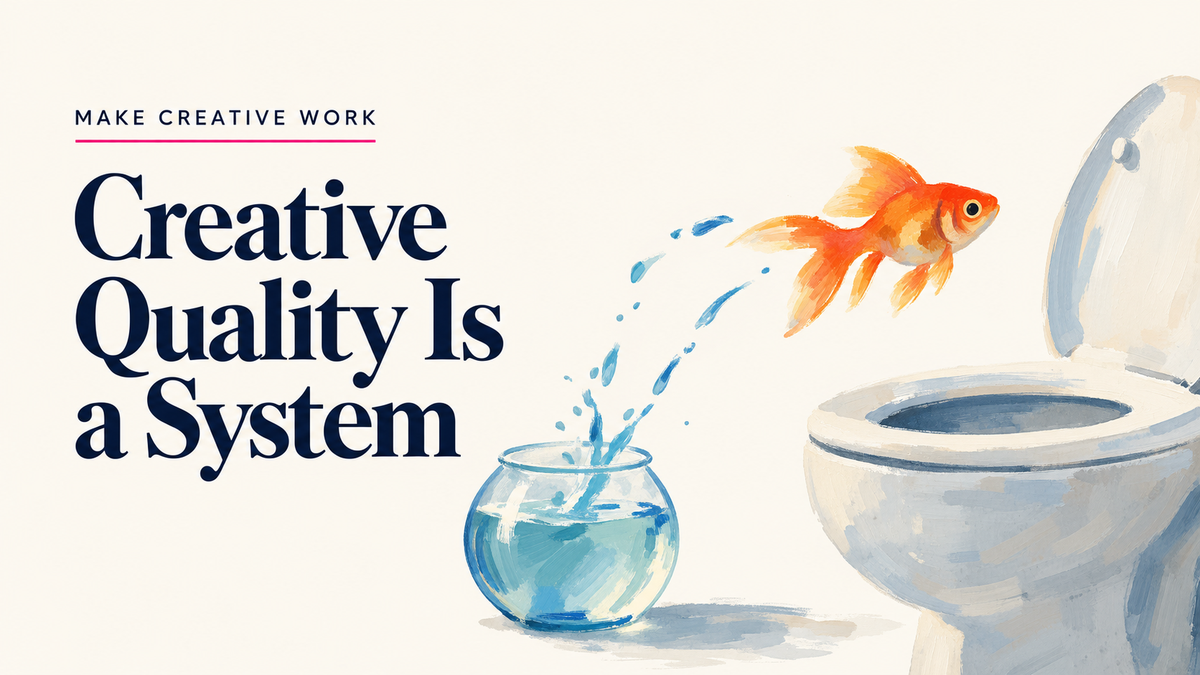
A couple of weeks ago, we held a goldfish funeral.
Not a real one. This is what our creative team jokingly calls the moment when a piece of work we love doesn't survive the feedback process.
This particular goldfish was a headline. It was smart, beautifully written and doing exactly what the creative concept needed it to do. Then, during review, we were asked to replace it with a reason-to-believe that had performed particularly well in testing.
There was nothing wrong with the reason-to-believe. In fact, it was useful information. Consumers were responding to it, and that mattered. But information that belongs in an ad isn't necessarily the idea that should lead the ad.
And so our lovely headline was sent off to the great toilet bowl in the sky.
As funny as our little funeral was, it got me thinking about something much bigger: We spend a lot of time talking about the quality of creative work as though it is primarily the responsibility of the people making it. Hire talented people. Give them a strong brief. Expect great work. But creative quality isn't just the product of creative talent.
Creative quality is a system. And feedback is one of the most powerful parts of that system.
Everyone has a stake in the work
Creative work in an organization is inherently collaborative.
Legal needs to protect the company from risk. Product teams understand what we're selling. Sales knows what they're hearing in the market. Consumer insights understands our audience. Brand teams protect positioning and consistency. Marketing leaders understand the business strategy. Executives have visibility into priorities the rest of the organization may not.
Creative needs all of that.
The answer isn't to shut the door to the creative department and hang a sign that says, "Professionals at work. Please don't disturb."
But there's an important difference between having a valuable perspective on the work and having expertise in every decision about the work. That's where feedback systems can start to break down.
When everyone involved in a project has equal authority to prescribe creative solutions, the work can slowly become an accumulation of individual preferences rather than a coherent response to a strategic problem.
The headline changes. The image changes. Something gets bigger. Something gets added. Something else moves up because someone wants to make sure people see it. Every individual request may sound perfectly reasonable. Collectively, they can dismantle the idea.

Know which lane you're representing
"Stay in your lane" sounds a little too territorial for the kind of collaborative organizations most of us want to build. But I do think there's something useful underneath the phrase.
Maybe the better principle is: Know which lane you're representing when you give feedback.
If Legal says a claim creates regulatory risk, that's expertise the work needs to accommodate. If Product says we've represented a feature inaccurately, that's expertise. If Consumer Insights tells us research shows a particular message is resonating with an audience, that's evidence we should take seriously. If Brand says something conflicts with established positioning, that's expertise.
But those inputs are different from deciding exactly how the creative team should solve the problem. That distinction matters. Consider our poor departed headline.
The fact that a particular reason-to-believe performed well in testing was valuable evidence. The organization absolutely should bring that information into the creative process.
But there's a difference between saying:
"This message is performing exceptionally well with consumers."
and:
"Replace the headline with this message."
The first gives the creative team information that should influence the work. The second prescribes the creative solution.
Maybe the right answer is to make that reason-to-believe more prominent. Maybe it should influence the concept. Maybe it belongs somewhere else in the hierarchy. And yes, maybe after considering the evidence, it really should become the headline. But that's a creative problem to solve.
Good feedback helps people understand the problem. It doesn't always need to hand them the solution.
Not all feedback is the same
One reason creative reviews become difficult is that we tend to throw everything into one giant bucket called "feedback."
It isn't all the same:
Some feedback is a requirement. There's a legal issue, a factual error, an accessibility problem or something the product absolutely must communicate.
Some is evidence. Research, testing, performance data or customer behavior tells us something important about how the work may be received.
Some is strategic feedback. The work isn't solving the problem we agreed to solve. We're speaking to the wrong audience, emphasizing the wrong message or drifting away from the objective.
Some is creative feedback. This is judgment about how the communication problem is being solved: the concept, hierarchy, language, art direction, execution or craft.
And some is simply preference. "I like the other photo better." "I wouldn't say it that way." "Can we make it blue?"
Preference isn't inherently bad. We're humans. We have opinions. The problem is when we treat all five categories as though they carry the same weight. They don't.

Feedback needs decision rights
This is where things get complicated in real organizations.
A neat little RACI chart can tell us who's responsible and who's consulted, but marketing organizations don't operate in perfectly clean boxes.
Product Marketing may serve a Product or Sales organization. Creative may support dozens of marketing teams. Legal has genuine authority over certain decisions. Consumer Insights has evidence that should shape the work. Marketing leaders are accountable for performance. The CMO is accountable for marketing. The CEO is accountable for the company.
Everyone reports to someone.
And ultimately, someone with enough organizational authority can make a decision whether or not that decision falls neatly within their area of expertise.
Pretending otherwise isn't useful.
The goal of feedback governance isn't to prevent people from having opinions or senior leaders from making decisions. It's to make clearer what kind of input we're receiving, what expertise sits behind it and who owns the decision.
If consumer testing tells us a message is powerful, we should listen. If Legal identifies a risk, we need to address it. If a senior leader decides a particular business priority outweighs the creative team's recommendation, that's a decision the organization can make. But we should understand the tradeoff we're making rather than allowing every piece of input to automatically become a creative instruction.
Great creative can die by a thousand reasonable requests
This is what makes the problem so difficult to see. Very few people walk into a creative review intending to make the work worse. They're trying to help.
They want the product represented correctly. They want an important benefit included. They want consumers to understand the offer. They want leadership to be happy. They want to reduce risk. They want the campaign to perform.
Every request has a rationale. But creative work depends on choices.
What do we emphasize? What do we leave out? What should someone notice first? What feeling are we trying to create? What is the one thing we want someone to remember?
If every stakeholder's priority has to become equally visible in the final execution, the creative team eventually loses its ability to answer those questions. Everything becomes important. And when everything is important, nothing is.
You can process your way out of a great idea
This is why I think creative quality has to be treated as an organizational design problem, not simply a talent problem.
You can hire brilliant designers and writers. You can give them a thoughtful strategy and a great brief. You can give them time to explore, challenge assumptions and develop something genuinely interesting.
Then you can put that work through six rounds of feedback with unclear decision rights, conflicting priorities and a system where the highest-ranking opinion wins.
You can't process your way to a great idea. But you can absolutely process your way out of one.
If an organization wants better creative work, it has to look beyond the people making the work and examine the environment surrounding them.
How does feedback enter the process? Who needs to contribute? What kind of expertise are they contributing? Who makes which decisions? What happens when feedback conflicts? Can the creative team respond to the problem, or are they expected to execute the proposed solution?
Those aren't administrative questions. They're creative quality questions.
Protect the idea, not the ego
None of this means Creative should always win. Creative people can fall in love with their ideas. We can miss something. Research can tell us something we didn't expect. A stakeholder may see a business problem we didn't know existed. Sometimes the thing we desperately want to protect really does need to change.
The point isn't to protect Creative from feedback. It's to create a feedback system that makes the work better.
That requires Creative to be curious rather than defensive when someone raises a concern. It requires stakeholders to distinguish between identifying a problem and prescribing a solution. And it requires leaders to create enough clarity around decision rights that every review doesn't become a negotiation among whoever happens to be in the room.
Sometimes the beautiful headline survives. Sometimes the evidence tells us it shouldn't. And sometimes someone with the authority to make the call simply decides it's time for the goldfish funeral.
That's the creative life. But if we're consistently watching our best ideas disappear down the great toilet bowl in the sky, it may be worth looking beyond the individual decisions.
The problem might be the system we're asking our creative work to survive.
Categories: Creative Ops, Leadership, Strategy