Creative Work Is a Folk Dance
Creative work may never be predictable, but the way teams work together can be repeatable. Here’s how the right amount of process creates clarity without constraining creativity.
There is a word I hear a lot when organizations talk about improving creative operations: predictable.
Predictable timelines. Predictable capacity. Predictable output. Predictable results.
I understand the appeal. Predictability makes planning easier. It makes executives more comfortable. It makes a spreadsheet look beautifully under control.
But I don't think creative work is predictable. And I'm not sure we should want it to be.
You don't know exactly how long it will take to land on the right idea. The first concept might be brilliant, or the team might need six rounds to get somewhere interesting. A seemingly straightforward assignment can uncover a much bigger problem. A difficult brief can suddenly click because someone asks the right question.
That's part of what makes creative work creative.
What I do think we can make is the way we work together more repeatable.
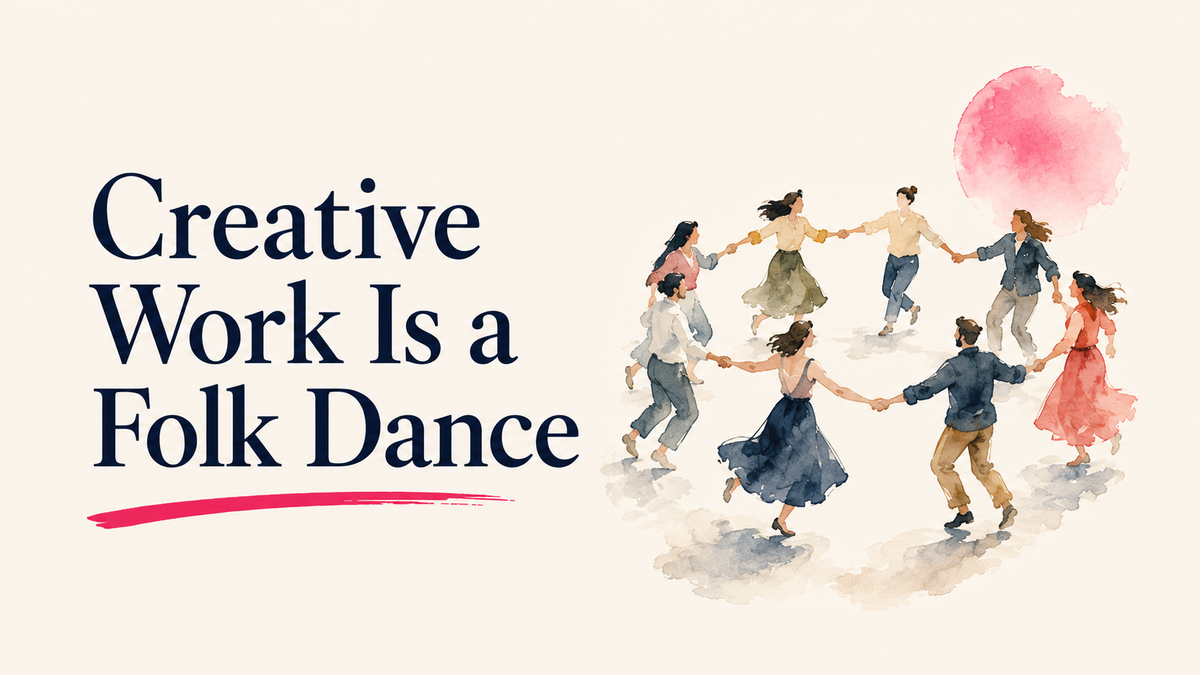
Think of it like a folk dance
I'm not much of a folk dancer, despite choosing this class as an P.E. elective in college, but I love the idea of one as a metaphor for creative work.
Everyone knows the basic steps. There is a rhythm. You know when it's your turn to move, when someone else takes the lead and generally where everyone else is supposed to be.
That doesn't mean every dancer moves exactly the same way. There is still personality, interpretation and energy. But there is enough shared understanding that everyone can participate without constantly stepping on someone else's toes.
That's what a good creative operating model should do.
The brief gives us a shared starting point. Roles clarify who is doing what. Priorities tell us which work matters most. Approvals establish who gets to make which decisions. Operating rhythms create predictable moments to check in, make choices and adjust.
None of those things tell a designer what to design or a writer what to write.
They simply help everyone understand the dance.
Process isn't the choreography
This distinction matters because process gets a bad reputation in creative organizations, and sometimes it deserves it.
Too little process creates chaos. Work arrives from everywhere. Priorities change without warning. Five people think they have approval authority. Creative teams spend more time figuring out what they're supposed to be doing than actually doing it.
Too much process isn't much better. Every decision requires a meeting. Every exception requires another approval. The organization becomes so focused on following the steps that nobody has room to respond to what's actually happening.
The right amount of process is a little like Goldilocks: It depends entirely on the organization.
A large, highly regulated company probably needs more structure than a small startup. A global organization needs different governance than a 10-person creative team. There isn't one perfect creative process waiting to be discovered and copied.
The goal is to find the amount of structure that is just right for the work and the organization. Enough that people know the steps. Not so much that we've choreographed every move.
Repeatability creates room for creativity
This is where I think Creative Operations sometimes gets misunderstood.
Our job isn't to make creative work behave like manufacturing. We aren't trying to guarantee that every project will take exactly 17 days or that every designer will produce precisely the same amount of work every week.
People aren't machines, and ideas certainly aren't widgets.
What we can do is remove the unnecessary uncertainty surrounding the creative work.
People shouldn't have to wonder where requests come in, what information they need before starting, which project takes priority, who needs to review the work or who ultimately makes the decision.
Those things can be repeatable.
And when they are, creative teams have more energy for the uncertainty that actually matters: solving the problem.
You can still improvise
The other thing I like about the dance metaphor is that knowing the steps doesn't mean you can't change them.
Maybe the music changes. Someone misses a cue. The room is smaller than you expected. A really good dancer sees an opportunity to do something different.
You adjust. Creative operating models should work the same way.
A good process gives people a default way to work together. It doesn't require them to blindly follow that process when circumstances call for something else.
The important thing is that everyone understands when they're departing from the normal steps and why. That's very different from chaos. It's intentional adaptation.
And I think that's ultimately what we're trying to create when we design better ways of working around creative teams: enough shared structure that people can move together, and enough freedom that they can still surprise us.
Creative work doesn't need to become predictable. But if everyone knows the steps and the timing, we can spend a lot less time stepping on each other's toes. And a lot more time making something worth dancing about.
Where does your creative process need more structure — and where could it use a little more freedom?
Categories: Creative Ops, Creative Teams, Ways of Working