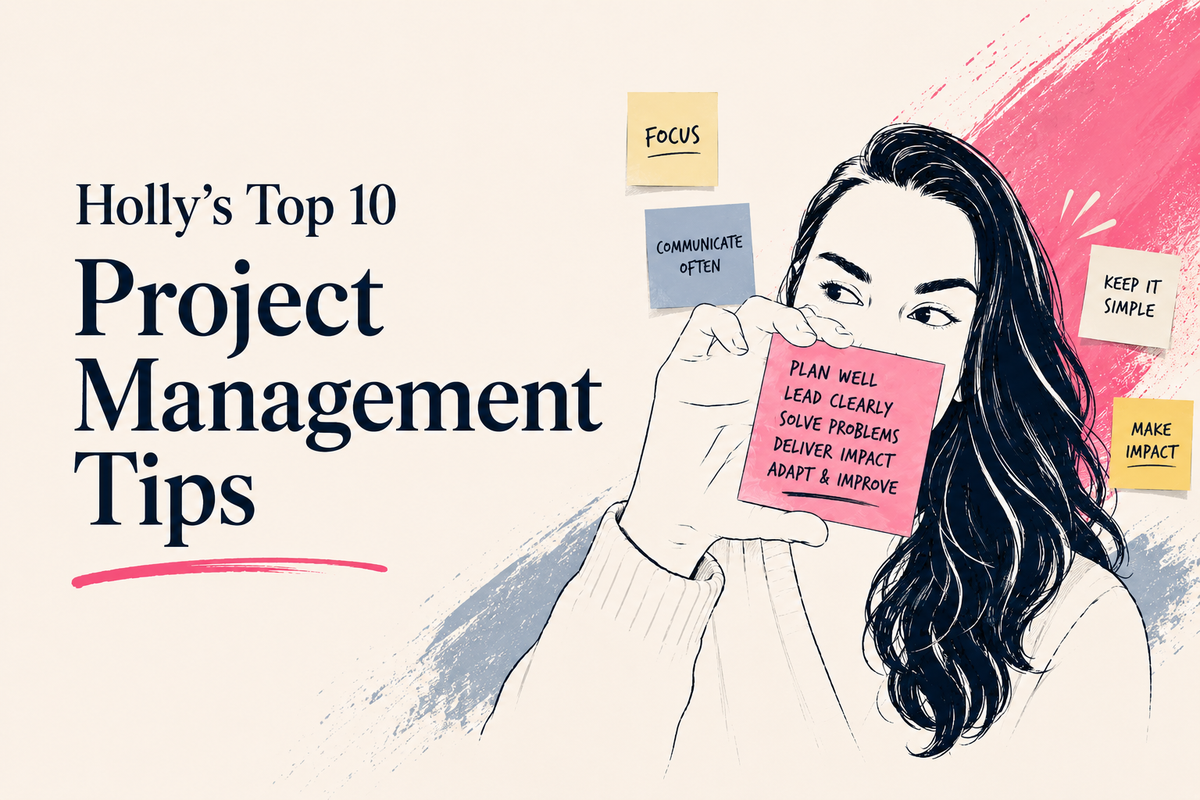
Holly’s Top 10 Project Management Tips
Ten practical project management tips from the trenches. Built for real creative teams, not textbooks. Learn how to manage shifting priorities, messy inputs, tight timelines and stakeholders without losing your sanity or your team.
Before Creative Ops, before operating models and measurement frameworks, I was managing day-to-day projects. The kind where timelines move, feedback shows up late and someone always has “just one more thought.”
I learned most of this the hard way. So I’m reaching back into that bag of tricks, not the textbook or PMI version. The version that actually works in a creative or marketing environment. Here are the ones I still use:
1. Build the movie in your mind.
Before you build the plan, walk the project from start to finish in your head. Picture the kickoff, the questions people will ask, the gaps in information and the handoffs between teams. If you cannot see how the project will unfold, you are not ready to plan it. This visualization method has saved me from project tragedy many times.
2. Define the vision and what success actually looks like.
Get clear on what you are really making and how it will be used. A lot of this should be in the brief, but you also need your own point of view on what success looks like for the business, the stakeholders and you as the lead. If success is vague, everything that follows will drift.
3. Find the stakeholders who are not in the room yet.
It's like an Easter egg hunt. There are always people who show up late with opinions that can change direction. Your job is to identify them early and bring them in, or at least plan for their impact. Surprises rarely help a timeline.
4. The beginning carries the project.
A strong kickoff sets expectations, builds alignment and creates momentum. A weak kickoff will follow you for the rest of the project. This is not a meeting to rush through or forget to plan.
5. Identify where the project could break.
Every project has a weak point. It might be too many stakeholders, unclear ownership or an unrealistic timeline. It is smart to think through what could go wrong early. You do not need to broadcast every concern, but you do need to plan for it.
6. Track decisions, not just tasks.
Projects do not stall because tasks are missing. They stall because decisions are unclear or undocumented. Keep track of what was decided, by whom and why. Do not rely on memory. Otherwise, you will find yourself in the final week of a project, re-reading emails to build the story of how something came to be.
7. Write things down as you go.
Capture notes, context and changes as they happen. There will be days where everything moves quickly, and you will not remember the details later. You do not want to be reconstructing a week from email threads late at night. Put it in a paper notebook, notes app, record it with your boombox, whatever works.
8. Call out tradeoffs without hesitation.
If new work is added, something else has to move. Say it clearly and without apology. Tradeoffs are part of the job, not a failure of planning. Being timid and not calling these out while come back to haunt you.
9. Structure feedback before you need it.
Define who reviews the work, in what order and against what criteria. If you leave this open-ended, you will lose time and create unnecessary churn. Have a very clear, direct email written to share out work for feedback. Set expectations and make the deadline clear. Follow up mid-way and send a day-of reminder in the morning.
10. Stay actively engaged.
Projects do not run on momentum alone. You have to stay close to the work, the people and the decisions. If you step back too far, the project will drift. Simply put, you have to care and you have to put in the work.