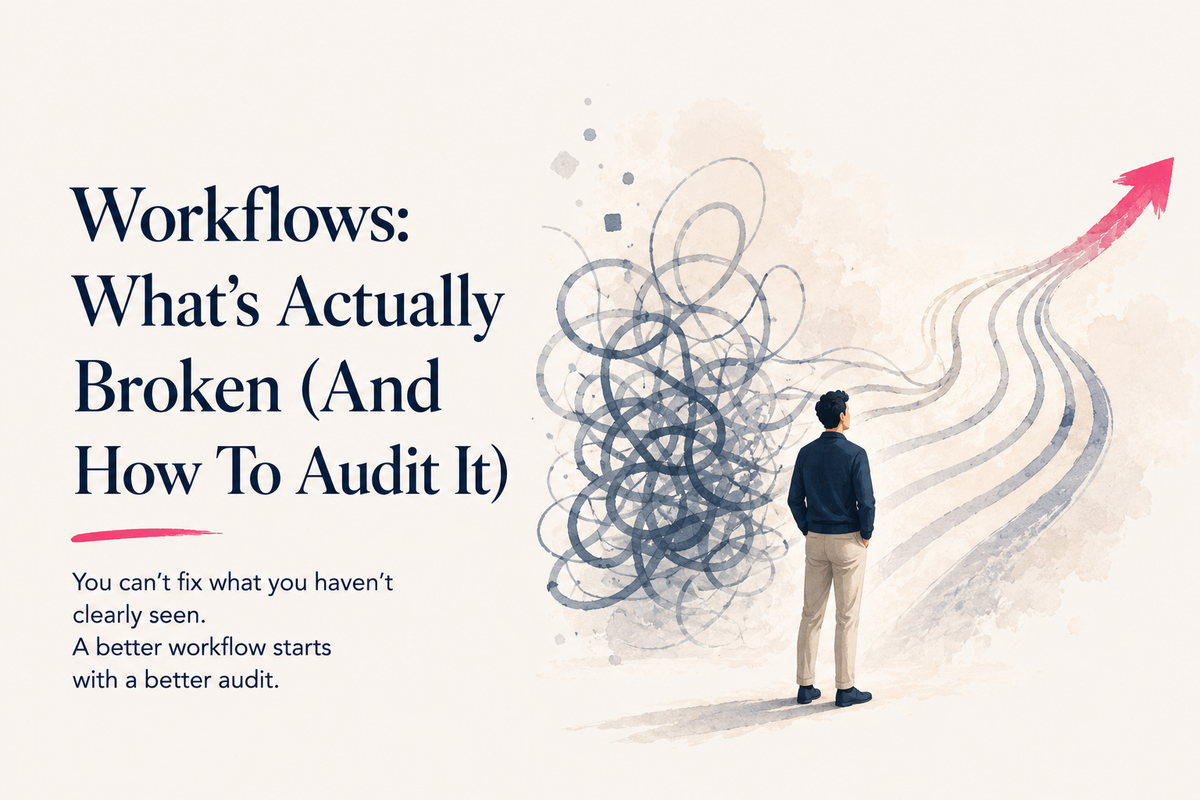
Workflows: What’s Actually Broken (and How to Audit It)
Most workflows aren’t broken end to end. They’re usually breaking in a few predictable places. The real work isn’t identifying what those places are. It’s knowing how to audit them and what to do when you find the issue.
Most workflows aren’t broken end to end. They’re usually breaking in a few predictable places. The real work isn’t identifying what those places are. It’s knowing how to audit them and what to do when you find the issue. Here are some common places where process is broken:
Intake
What to look for:
- Briefs missing key inputs like audience, goals or success metrics
- Strategy skipped or rushed because “we just need to get it out”
- Scope shifting after work has already started
How to audit it:
- Review a sample of recent briefs
- Ask the team what they always have to go back and ask for
- Track how often projects restart or get re-scoped
How to govern it:
- Define a minimum viable brief and don’t start work without it
- Build a clear intake gate that requires key fields before kickoff
- Call out when work is starting without strategy and make the tradeoff visible
Example: “We can absolutely move quickly on this. To do that well, we need clarity on audience, goal and success metrics. Without that, we’ll likely add time later in revisions. Can we take 30 minutes to align before we start?”
Approvals
What to look for:
- Approval lists changing mid-project
- “Drive-by” feedback from new stakeholders
- Multiple people acting like final decision makers
How to audit it:
- Compare planned approvers vs. actual approvers on recent projects
- Look at how many rounds of feedback happen and why
- Identify where decisions stall
How to govern it:
- Lock approvers at the start and make changes visible
- Define a single accountable decision maker
- When new approvers are added, quantify the impact
Example: “We’re glad to have additional input. Adding this reviewer will likely extend the timeline by 1–2 weeks. Are we aligned on that?” Make the tradeoff explicit so it’s a decision, not a surprise.
Handoffs
What to look for:
- Work coming into the next phase incomplete
- Teams redoing or reinterpreting work
- Constant back-and-forth to clarify what should have been clear
How to audit it:
- Sit in on a few live handoffs
- Ask where teams feel like they’re “starting over”
- Look for repeat clarification questions
How to govern it:
- Define what “ready” means before work moves forward
- Create simple checklists, not heavy process
- Hold the line on incomplete work moving ahead
Example: “This isn’t quite ready to move to design yet. We’re missing final copy direction and approved messaging. If we move forward now, we’ll likely redo work. Let’s close those gaps first so we can move faster overall.”
Ownership
What to look for:
- Work sitting because no one is clearly driving it
- Multiple people contributing but no one accountable
- Decisions lingering without resolution
How to audit it:
- Ask “who owns this?” at each stage and see if the answer is clear
- Track where work pauses without action
- Look for duplicate effort or missed follow-through
How to govern it:
- Clarify who is responsible and who is accountable
- Align on roles, especially after a re-org when things shift
- Reinforce ownership in day-to-day work, not just in documentation
Example: “To keep this moving, we need a single owner accountable for final delivery. Who is driving this end to end so we can avoid delays and confusion?”
Single points of failure
What to look for:
- One person who has to touch everything
- Specialized knowledge that only lives with one team member
- Work piling up behind a single role or skillset
How to audit it:
- Identify where work queues up consistently
- Map dependencies tied to specific individuals
- Look at vacation coverage and what breaks
How to govern it:
- Cross-train and document critical workflows
- Distribute decision-making where possible
- Plan for redundancy before it becomes a fire drill
Example: “Right now, all final approvals are routing through one person, which is creating a bottleneck. If we want to move faster, we should define where decisions can be delegated or supported by others.”
Most teams feel like their workflow is broken because they’re experiencing the symptoms across everything. But the root cause is usually sitting in one or two of these areas. If you can audit these points and put simple guardrails in place, you don’t need a full redesign. You need a few well-placed fixes that actually hold.