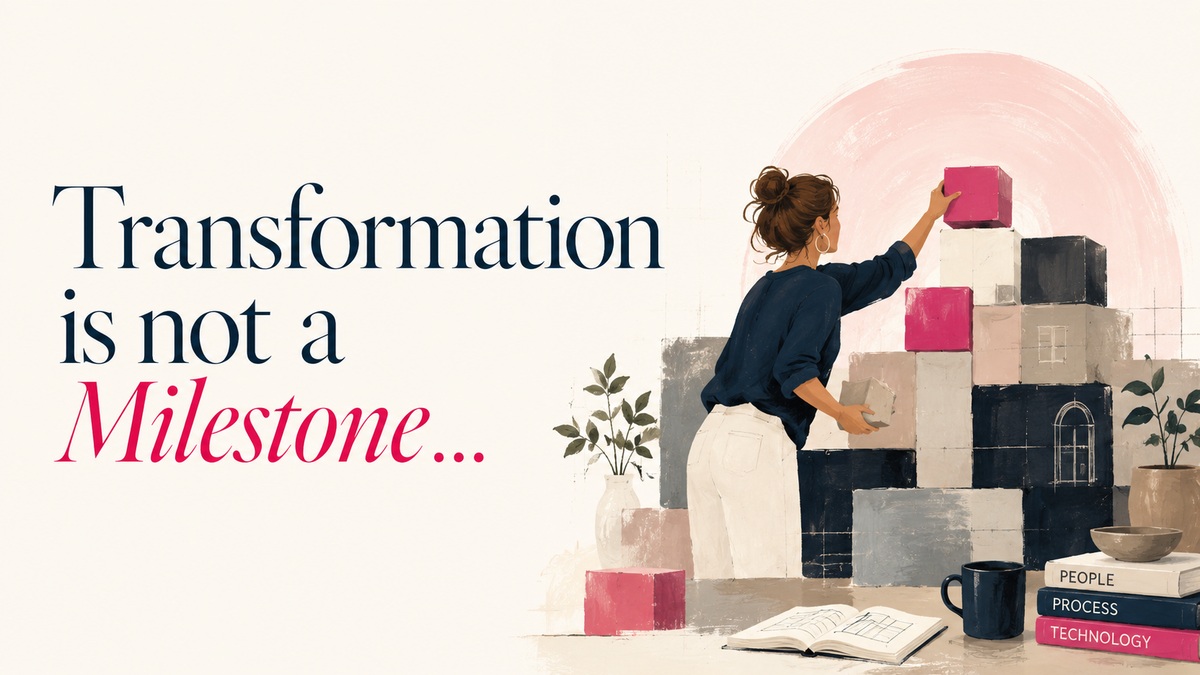
Transformation Is Not a Milestone
Transformation isn’t a milestone. Lessons from Amy’s, Visa and AAA on organizational design, continuous improvement and building systems that evolve with the work.
My last three organizations could hardly have been more different.
At Amy’s Kitchen, I joined a Creative team that still moved work around in plastic docket bags and stored photography on CDs in bankers boxes. At Visa, I worked inside an enormous global matrix, coordinating digital work across more than 100 websites, dozens of languages and teams around the world. Today at AAA, I’m helping rethink how Marketing and Creative work together across a complex Membership organization.
The technology has been different. The scale has been different. The organizational problems have been different.
But there has been a common thread in the work: Looking at how people, processes, technology, information and decisions fit together, then asking how that system could work better.
What interests me most isn't efficiency for efficiency's sake. A faster broken process is still a broken process. The goal has been to create organizations that collaborate better, see the whole picture, make better decisions, produce stronger work and ultimately create better experiences for customers.
And looking across these experiences has reinforced something I believe pretty strongly: We need to stop thinking about transformation as something an organization periodically completes.
The pace of change has made the idea of a “finished” operating model increasingly unrealistic.
Different organizations, same underlying question
At Amy’s, modernization was wonderfully tangible. Creative work traveled around in plastic docket bags. Photography lived on CDs. As the company grew, those ways of working simply couldn't support hundreds of products, packaging changes, digital content, photography and an increasingly complex creative operation.
So we changed them.
We centralized imagery in Bynder and created governance around how assets were managed. We developed workflows for ingesting new photography. We used Smartsheet and Bynder to manage requests and work. We introduced Esko WebCenter for packaging production. We even brought large-format color proofing in-house because waiting for externally produced packaging proofs was slowing down reviews.
Each change solved a practical problem, but together they did something larger. They gave people better access to information, created more visibility into the work and made collaboration easier.
And some of the most valuable changes had nothing to do with technology.
Our Customer Care team sat with Marketing. Every two weeks, we met to hear directly what customers were telling us. We heard recurring complaints and emerging issues that Marketing could respond to quickly, particularly through social. We also heard the love stories: the products people couldn't live without, the memories they associated with Amy’s and the reasons the brand mattered to their families.
It created a direct feedback loop between the people hearing from customers and the people communicating with them.
The system got smarter because we connected people who had information other people needed.
Same idea, very different scale
At Visa, the operating environment couldn't have been more different.
We were managing digital work across a massive global ecosystem, with regional teams, more than 100 websites, dozens of languages and all the complexity that comes with operating inside a large, highly regulated organization.
Another Visa team was already using Wrike. It had cleared the enterprise hurdles and had the capabilities we needed, so there was little reason to spend months searching for a theoretically perfect platform.
We could get to the more important questions instead.
How should work enter the team? Who needed visibility? What should be standardized globally and what needed regional flexibility? How should teams collaborate across time zones? Where was work getting stuck? How could we understand capacity? What information did leaders need to make decisions?
Wrike helped us operationalize the answers, but implementing Wrike wasn't the accomplishment.
Changing the way the organization worked was.
Over time, productivity increased 54%, output increased 217% and delivery timelines decreased 30%. Technology helped enable those results, but the larger change came from redesigning the system around the work.

And now the questions have changed again
At AAA, I find myself working on another version of the same challenge.
Creative had been managing work primarily through Airtable, while the company's PMO was already using Asana. Like Wrike at Visa, Asana gave us an enterprise-ready platform without starting a lengthy technology selection and procurement process.
But again, the platform quickly became secondary to the organizational questions.
How should Marketing bring work to Creative? What makes a request ready? How do we distinguish strategic initiatives from tactical production? How do we help marketers bring Creative a problem to solve instead of documenting the execution they've already imagined? How do we prioritize when demand exceeds capacity? What work belongs with our internal Creative team, what should go to production partners and what can safely become self-service?
Those questions have led us well beyond workflow.
We’ve introduced a new strategic Creative Brief framework and are coaching marketers on how to use it. We’re rethinking prioritization, resourcing, production pathways, governance and measurement. We’re using AI inside the operating model to review requests, identify missing information, surface risks and take administrative work away from people.
Asana is important because it gives those decisions somewhere to live.
But once again, the tool isn't the transformation. The change in how the organization thinks and works is.

Borrowing a good idea from engineering
None of this makes continuous improvement a new concept. Engineering and software development figured this out long before Marketing did.
What I think Marketing and Creative organizations can borrow is the assumption that the system itself is always open to improvement.
That distinction matters.
Continuous improvement shouldn't mean endlessly squeezing another 5% of efficiency out of the same workflow. Sometimes the right question isn't “How can we make this faster?”
It's “Why are we doing this at all?” Is this handoff still necessary? Does this approval improve the work? Should a person still be doing this task? Are we organized around the work customers need today? What information isn't moving between teams? What has technology made possible since we designed this process? What are customers telling us that our dashboards aren't?
And with AI rapidly changing the economics and mechanics of knowledge and Creative work, those questions are becoming harder to postpone.
The operating model should never be finished
This may be the most important common thread across my experiences.
At Amy’s, Visa and AAA, the objective was never simply to make work move faster. It was to build a more connected organization: better collaboration, greater visibility, smarter decisions, stronger work and ultimately better experiences for the people we were serving.
The solutions were different because the organizations were different. And the solutions kept changing because the organizations kept changing.
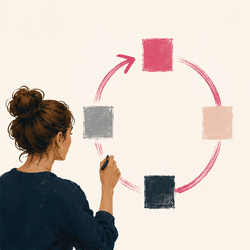
That's why I increasingly think of transformation less as a project and more as an ongoing organizational capability.
A workflow that works beautifully today may not make sense three years from now. A governance model that solves one problem can eventually create another. AI may eliminate work we've spent years optimizing. Customer behavior will change. New channels will emerge. Business priorities will shift.
The organizations that thrive won't necessarily be the ones that complete the biggest transformation programs.
I suspect they'll be the ones that become particularly good at changing themselves continuously without losing sight of why they're changing in the first place.
For Marketing and Creative organizations, that reason should ultimately be pretty simple:
Do better work for the people we're trying to serve.
Everything else — the workflows, platforms, processes, org charts and increasingly the AI — is just how we get there.